
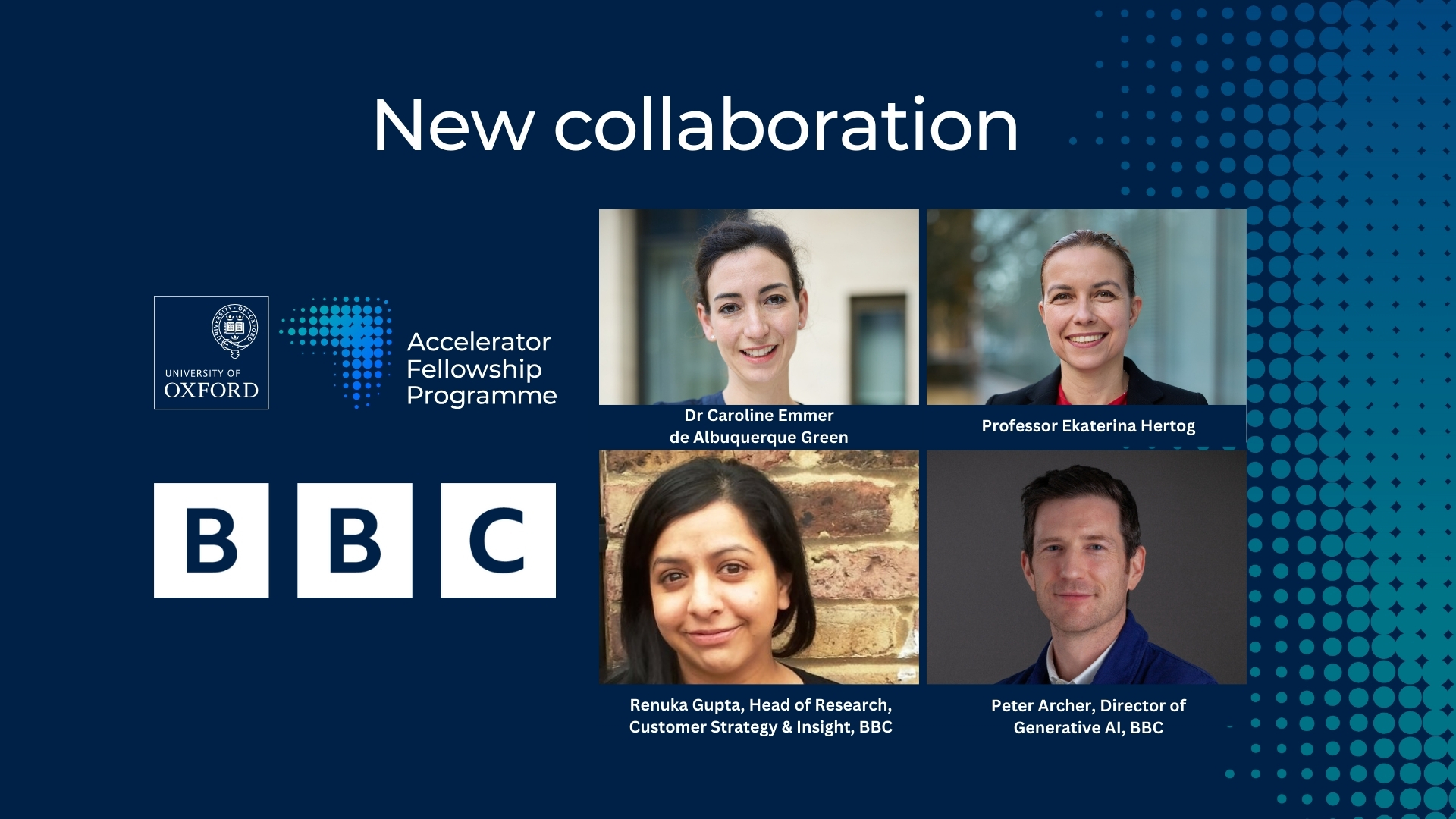
As generative AI tools become an increasingly common source of information for young people, questions of trust, accuracy and influence are coming sharply into focus. In response, the Accelerator Fellowship Programme of the Institute for Ethics in AI is announcing a collaboration with the BBC on a new project entitled “Truth & Trust: AI and Young People”.
The collaboration will look in detail at the critical issue of trust in AI. It will explore how young people (aged 16-24) use AI to make sense of the world around them; the extent to which they trust AI as a source of information and the issues and opportunities this creates.
The project seeks to combine BBC research expertise with academic insight from ethics, psychology, and youth development. Its findings will help shape how the BBC continues to support audiences across the UK in navigating AI.
Dr Caroline Emmer de Albuquerque Green, Director of Research at the Institute for Ethics in AI, and Director of its Accelerator Fellowship Programme, will be working alongside Associate Professor of AI and Society, Dr Ekaterina Hertog, Peter Archer, Director of Generative AI at the BBC and Renuka Gupta, Head of Research, Customer Strategy and Insight at the BBC to deliver this research project. It focusses on key themes such as:
How young people engage with generative AI in their information-seeking;
How much young people trust AI-generated information;
How young people from different socio-economic backgrounds engage with AI-generated content;
The risks that young people face when using AI-generated content and how to reduce them;
What new opportunities AI-generated content opens up for young people;
What ‘good’ use of AI-generated content could look like.
When speaking about this new collaboration, Dr Caroline Emmer de Albuquerque Green said: “As AI continues to reshape societies worldwide, we believe it is important to explore how young people are using AI tools as they increasingly enter our lives. We are keen to learn more about the level of trust young people have in these new technologies, especially when it comes to seeking information about what is happening in the world. We are very excited to be working with the BBC on this project, who are at the forefront of wanting to understand how young people access information that is trustworthy”.
Peter Archer, Director of Generative AI at the BBC, said: “This collaboration with the Oxford’s Institute for Ethics in AI is an exciting step forward in a critical area. We'll better understand how young audiences experience and trust AI, and how we can best support them as they navigate an AI-shaped world. Like all new technology, AI brings exciting possibilities but also challenges. Research like this will ensure the BBC continues to place our audiences’ needs at the heart of all our innovation with AI".
The early findings of the “Truth & Trust: AI and Young People” project will be shared in summer 2026. Updates will be made available on the Accelerator Fellowship Programme website.
Note for Editors
Dr Caroline Emmer de Albuquerque Green and Professor Ekaterina Hertog are available for interviews. For more information, please contact: aiethicscomms@philosophy.ox.ac.uk
About the University of Oxford
Oxford University has been placed number 1 in the Times Higher Education World University Rankings for the ninth-year running, and number 3 in the QS World Rankings 2024. At the heart of this success are the twin-pillars of our ground-breaking research and innovation and our distinctive educational offer.
Oxford is world-famous for research and teaching excellence and home to some of the most talented people from across the globe. Our work helps the lives of millions, solving real-world problems through a huge network of partnerships and collaborations. The breadth and interdisciplinary nature of our research alongside our personalised approach to teaching sparks imaginative and inventive insights and solutions.
Through its research commercialisation arm, Oxford University Innovation, Oxford is the highest university patent filer in the UK and is ranked first in the UK for university spinouts, having created more than 300 new companies since 1988. Over a third of these companies have been created in the past five years. The university is a catalyst for prosperity in Oxfordshire and the United Kingdom, contributing £15.7 billion to the UK economy in 2018/19, and supports more than 28,000 full time jobs.