
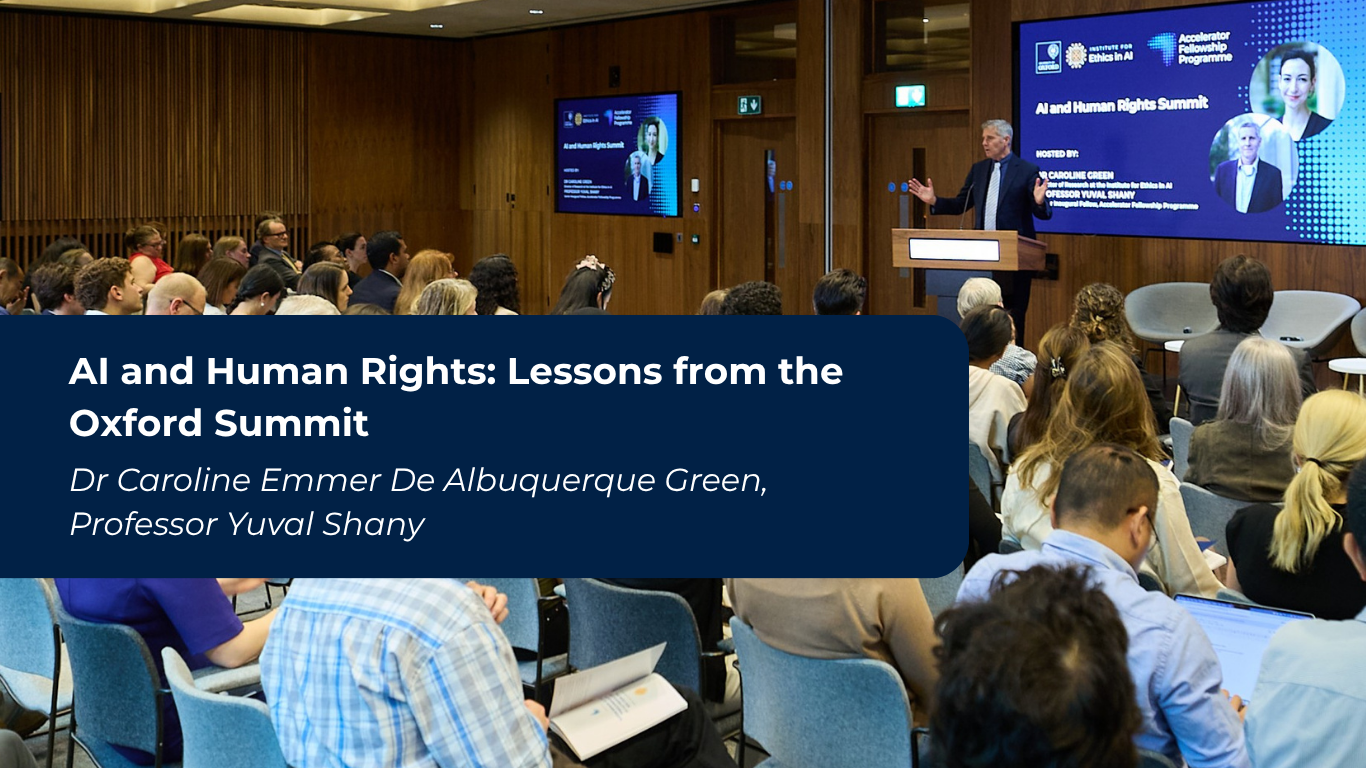
By Dr Caroline Emmer De Albuquerque Green (Director of Research at the Institute for Ethics in AI) and Professor Yuval Shany (Senior Inaugural Fellow of the Accelerator Fellowship Programme).
AI systems, the way they are developed and used, and the resources and conditions AI needs in order to exist and evolve all have immense impacts – on us as humans, on our environment, and soon on outer space too. Framing these impacts as human rights issues is not just a matter of language. It gives us a foundation from which to recognise the implications of AI for humanity, and a shared vocabulary for identifying needs and interests, making concrete demands and holding those responsible to account.
At the AI and Human Rights Summit, held in Oxford on 5 October, 2026, we structured our discussions around three key questions: what is missing, what needs to change, and how can a change be brought about. We wish to bring together here what we heard from participants in the Summit – their frustrations, ideas, and disagreements – and set out where we can perhaps proceed from here.
The starting point of our debates is a familiar one. Where once it was clear that human rights duties and responsibilities principally lay with governments, we now have private sector companies firmly in the mix, often in charge of determining the pace and general direction of technological developments. The role of tech companies, the speed of developments, the whole-of-society disruptive effects of AI systems and the level of uptake of AI products and services by individuals and governments alike mean that traditional human rights protection mechanisms do not easily adapt onto these new social, economic and political realities and power structures. There are already many ideas, approaches and useful examples out there, but we are still meeting real limits in our ability to map and address human rights impacts in real time – and to avoid harm in the first place.
What is missing?
The message emanating from the room was clear: we need binding regulation, not abstract ideals. Many participants felt that the legal gaps and challenges posed by AI simply cannot be bridged by non-binding standards; instead, they called for gradual movement towards a comprehensive, global treaty on AI and human rights. Because harms caused or facilitated by AI systems so often cross borders, there was also a parallel call for mutual legal assistance agreements between countries once a jurisdictional issue relating to efforts to secure legal accountability and obtain remedies arises.
Alongside concerns about regulation sit concerns about enforcement. As one participant put it, lack of enforcement happens mainly to those lacking in power. By contrast, powerful politicians or CEOs too often operate with impunity in this policy space. Rules that only reach the weakest actors in the AI development and use ecosystem will not protect anyone.
Some of the sharpest reflections offered in the Summit were about the laws we already have in place. The difficult questions confronting us might have less to do with what is actually missing from the law books – for example, whether the right to freedom of thought under the European Convention on Human Rights or the International Covenant on Civil and Political Rights includes protection from AI-driven digital manipulation – and more with whether existing legal provisions can continue to develop at the right speed and in the right way, without courts and other law-appliers running into accusations of judicial activism and/or overreach, especially in the current political climate. Apropos the political climate, one participant even questioned the practical utility of using extensively the label of human rights, as opposed to labels like safety, trust or inclusiveness, for getting the support of some major stakeholders.
The environment came up again and again in our discussions, with calls for more robust protections of rights and prevention or mitigation of risks. The rights of residents living near data centres, the risks to local infrastructure from energy demand, and the very real threat of reduced access to clean drinking water were all mentioned in this regard. These environmental concerns sit in tension, however, with certain notions of data sovereignty. It remains to be seen how states and other stakeholders would deal with these tensions, and what would protecting data sovereignty while respecting human rights actually look like. What’s more, most data centres are currently in the Global North, yet simply relocating them to the Global South would shift the associated environmental burdens onto communities, the environment and electricity grids there. This might further exacerbate the digital divide between those who carry risks and those who attain benefits, and between those who have a seat at the policy making table and those who are not even in the room where it happens.
Children, too, are often missing, or included only at the margins of discussions about AI and human rights, even though they are the ones who will bear the longest the brunt of AI's impact on their lives. Most discussions of AI governance and rights assume a fully autonomous adult from the outset. One participant questioned explicitly, in this regard, whether we are adequately protecting the right of humans to realise their full cognitive capacity.
A major gap in the process of addressing adverse impacts that was identified in the Summit is the lack of reliable, independent evidence. It was maintained that we need rigorous, generalisable data on how AI affects people's lives – especially children and vulnerable groups – covering both benefits and harms, alongside climate impacts and the energy, water and land use of data centres. Those developing and deploying AI should arguably be required to support independent research into related impacts and to disclose the relevant findings. Without a good body of evidence, it is hard to know whether protections are adequate, or to hold anyone accountable. Several participants in the Summit asked, in that connection, for the development of concrete measurements and scoring mechanisms to match.
The discussions also underscored that we need to develop clearer thinking about the practicalities of having a human "in the loop" or "on the loop", and some have argued that human control should be articulated clearly as a human right entailing independent legal obligations. Underneath all of these normative concerns about control, oversight and automated decision-making lie questions of structural and institutional resources, capacity, power and credibility.
To be sure, not everyone agreed that something is missing. One participant answered simply the question what is missing with one word: nothing. What we need instead, in their view, is a crisp re-articulation of why human rights matter in this policy space, and a focus on what meaningful oversight looks like – helping technical and safety experts to experiment with, surface and pioneer relevant human-centric techniques. Another asked whether the existential warnings we have become used to around AI offer an opportunity for human rights to reassert its relevance, or rather serve as a form of distraction from engaging seriously with human rights.
What needs to change?
One speaker offered an analogy that stayed with many of us. When the first lightbulbs were rolled out, faulty wiring was causing fires, and it was the property owner or the installer who was left liable while the manufacturer was absolved from liability. The law did catch up eventually, but until it did, many users were left vulnerable. With AI, we are arguably living in that same gap right now.
So where should liability sit? Participants argued for shifting accountability upstream – updating legal frameworks so that liability rests with the individuals and organisations who define an AI system's goals and parameters, rather than with the "human in the loop" who is simply monitoring its output. Some went further and asked whether it is time to adapt and integrate, more durably, laws on personal liability – civil and criminal, depending on jurisdiction – for harm caused by AI, whether intentional or not. Transparency was raised many times in this context, and participants pointed to the recent child safety cases involving Meta as a reminder that Big Tech has, on several occasions, resisted transparency and accountability and has worked against user protections rather than for them.
The biggest issue, as one participant put it, is accounting for private power. Perhaps we need to rethink the dichotomy between the state's duty to protect and business's responsibility to respect, which was not designed with companies operating at the scale and reach of today's tech giants in mind. One participant had a bold idea in this regard: To develop a periodic review of compliance with human rights standards for the major AI companies, modelled on the periodic review conducted for states by UN human rights treaty bodies. Such a process would generate a degree of transparency and accountability, and help to recentre human rights in AI governance.
There were also concrete proposals on the technical side. International bodies should codify technical standards for transparency and traceability (the t3ai model was given as one example) – not just as good practices, but as baseline expectations for any enterprise deploying autonomous agents. Regulation could require systems, for example, to have inherent circuit breakers and immutable audit trails by design. It was also asserted that we need to stop treating human oversight as an optional layer for some AI systems. and start treating it as a non-negotiable functional requirement.
Principles matter too. It was claimed that it is important for the international community to affirm digital rights as human rights. The Universal Declaration of Human Rights was able to kickstart our human rights culture, even though its direct legal impact was limited at first. Being clear on our principles for the age of AI, and gradually elaborating on what they actually entail in specific use cases, would be major steps forward.
In the meantime, we should get existing oversight bodies to do their job. One participant raised another bold question – whether a framing of widespread or systematic AI-driven harms of a serious nature as crimes against humanity could act in certain policy spaces as a deterrent for the most powerful actors in tech. Whether moving in this direction is legally and politically workable is very much an open question. Still, it says a great deal about how strongly some people feel about the unacceptability of the current state of affairs in which our normative frameworks lack teeth.
How can a change be brought about?
Unfortunately, none of these normative or institutional developments will happen through professional conferences or the publication of innovative policy papers. Indeed, participants in the Summit were realistic about what needs to change around us in order to make reforms in the field of AI and human rights possible.
First, we need the right voices in the room and, as one participant put it bluntly, not just politicians. Second, those who build AI systems need to understand what is at stake. One proposal made was mandatory education on ethics and the risk of harm for software developers, following a process similar to what medical students and doctors have to go through: extensive and explicit teaching on the impact on users, on public understanding of technology and on the real costs of malfunctions and hallucinations for real people. Third, we need to mobilise civic participation through citizen education, so as to allow the public to take part effectively in these debates rather than watch them from the side lines.
Some participants made another important observation: AI harms that are visible are much easier to respond to – and much easier to take up with the companies developing and deploying AI. A large part of our task, then, is to make invisible harms more visible.
This connects to another proposal we found interesting. One tool the field already uses to discover what AI is capable of – for harm, but also for benefit – is genuinely independent technical evaluation at the model level, alongside impact assessment. One participant read our discussion as an invitation for the UN Office of the High Commissioner for Human Rights or the UN treaty bodies to develop this kind of independent technical capacity, or to link up with global academic partners in order to do so. It is a proposal worth taking seriously. It would give human rights bodies their own evidentiary basis, rather than relying on what companies choose to disclose or fail to hide. We need to be honest, however, about the limits of this proposal: Model-level testing cannot capture every harm that emerges once systems are deployed in particular contexts. Encouragingly, work is already under way, including the evaluation of models against individual human rights and against international humanitarian law, and those involved have offered to contribute to new and relevant capacity development initiatives.
What can be done right now?
AI governance frameworks often lack altogether human rights language, and existing frameworks for human rights protection – be they international, regional or national – are of only limited use at this moment in addressing the impacts caused or facilitated by AI systems. However, Summit participants provided several good ideas about what can be done right now to improve upon the current situation:
1: Build on what is already being done at the national level. There are several initiatives and legal developments that are helping to articulate clear duties and best practices under existing frameworks, and that make the abstract interest in foregrounding human rights in AI governance more actionable.
2: Champion a human rights-based approach. While we may agree on the value of a human rights-based approach to understanding AI risks, harms and benefits (and the recent Human Rights Council Resolution 63/15 is a step in the right direction), we are far from having human rights language present at the centre of governance and regulatory debates around AI. Other values and concepts, like safety, trust and inclusiveness, are far more widely used. As a human rights community, we should keep working to reclaim and champion human rights language in international, regional, national and local frameworks for AI governance – not just at government level, but within tech companies too. Part of this means connecting human rights to other discourses, including environmental justice and sustainable development goals, and calling out deceptive narratives and agendas, including the claim that human rights and innovation are incompatible.
3: Bake human rights into technology from the beginning. While we wait for human rights frameworks designed specifically with AI in mind to take further shape, it is vital to strive to make, where possible, human rights central to engineering standards, to investor due diligence, and to existing corporate responsibility procedures, including applicable methodologies for determining how AI technology and its impacts are assessed and evaluated.
4: Involve civil society, impacted communities and individuals at all levels. When addressing human rights implications as they play out in the real world, we should make all efforts to hear from the communities and individuals who are most affected. More work is needed in global and regional fora on bridging digital divides, and in making sure we use language on AI and human rights that is accessible to everyone.
5: Collaborate, and build spaces to work with each other. This could mean, for example, for UN treaty bodies to start working together on how to respond to the AI challenge, or in bringing different ethics communities to deliberate together, across national, regional and global lines. We also need the US and China around the table, and to find ways to pool resources to fund new initiatives.
The road ahead
The Summit did not give us easy clear-cut answers – and it would have been surprising if it had given the complexities of incorporating human rights into AI governance and the diversity of voices participating in this discussion. What it did give us was a clearer sense of a sense of urgency regarding the need to foreground human rights. It also helped us to identify where the gaps are and who needs to act to close them: We would eventually need binding rules with real enforcement, informed by human rights rules and principles adapted to the challenges posed by AI, accountability at the national, regional, global level that reaches the powerful, independent evidence gathering and analysis, and bringing the people most affected – children and marginalised communities included – into the centre of the conversation.
To be sure, AI also holds real potential to advance human rights, as one speaker has reminded us, but realising that potential depends on getting the normative foundations right and on ensuring effective monitoring. Human rights gave the world a shared language for human dignity, liberty, equality and solidarity once before. Our task now is to make sure that language shapes the age of AI, rather than being written or coded out of it, or being ignored in practice.
-
Suggested citation: Dr Caroline Emmer De Albuquerque Green and Professor Yuval Shany, 'AI and Human Rights: Lessons from the Oxford Summit', (02 November 2026), AI Ethics at Oxford Blog, https://www.oxford-aiethics.ox.ac.uk/blog/ai-and-human-rights-lessons-oxford-summit