
AI, the potter’s wheel and the human capacity for invention
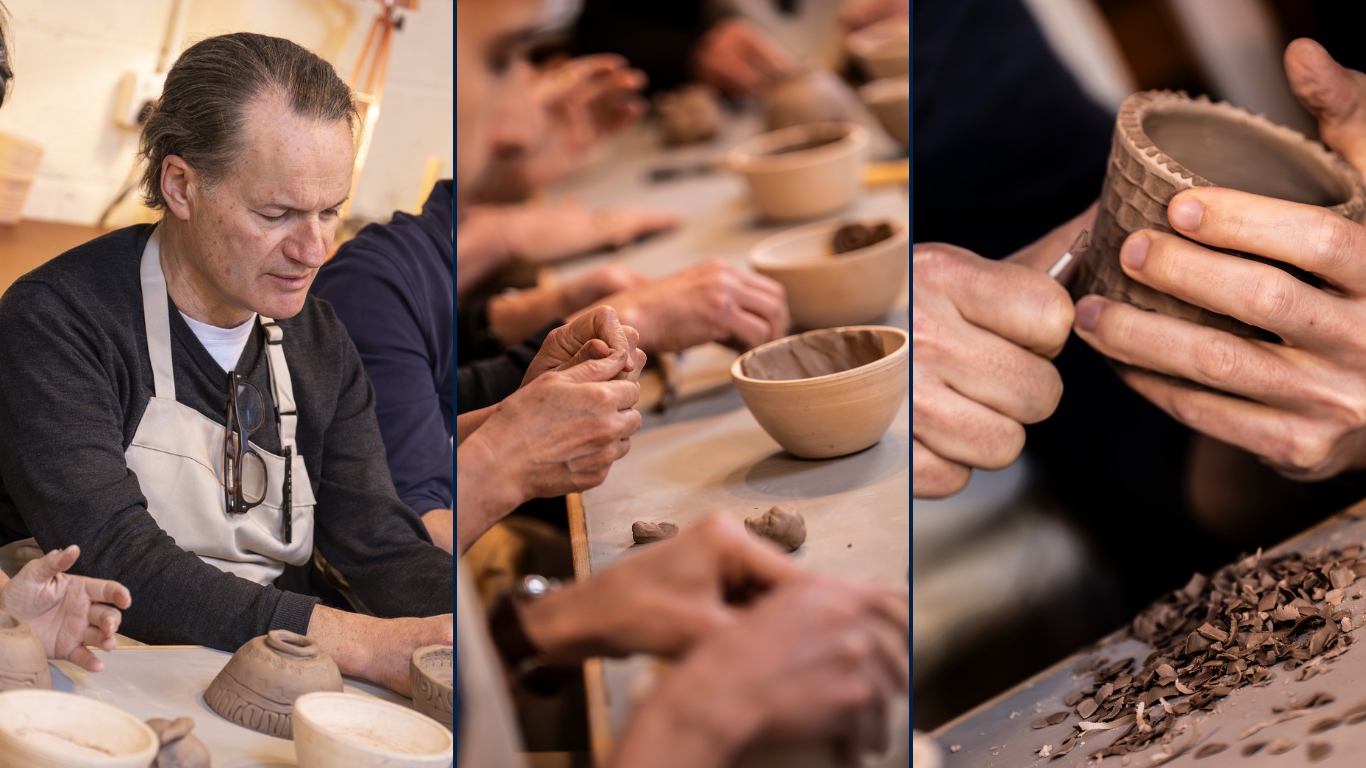
As part of the preparations for the grand public opening of the Schwarzman Centre for the Humanities on 25 April, I attended a fascinating pottery workshop hosted by artist and designer Es Devlin and Dr Robin Wilson, Director of Oxford University Kilns. By sharing this experience in clay-making – in which none of the invitees, least of all myself, had any expertise – we created a relaxed neutral space in which we opened up a conversation about AI. But beyond facilitating conversation what, if anything, have pottery and AI to do with each other? Is there a deeper connection?
Let me begin with a story. Those of you with long memories will remember the debate in the Labour Party, during Tony Blair's first administration, about the abolition of clause IV of the party's constitution. Clause 4 referred – if I remember rightly – to ‘state ownership of the means of production, distribution and exchange … to secure to all workers by hand or brain the full fruits of their labour’. Because it was the ‘socialist’ clause in the constitution, the right of the party wanted to get rid of it and the left wanted to keep it. So, when Tony Benn - a leading representative of the left – was asked on television whether there was anything in it he would change, it was a surprise when he answered yes. What he said - good PPE student that he once was – was that in the bit about ‘all workers by hand or brain’ he would substitute the word ‘and’ for the word ‘or’ because every worker is a worker both by hand and brain. We use our hands even when we're typing instructions on a computer keyboard, and we use our brains when doing so-called manual work - like making pots on the wheel.
Though scarcely what Benn is best known for, that’s a useful thought to start with. For whatever their gross differences, AI and the potter’s wheel are both manifestations of the human capacity for invention. But how much further does the similarity go? And where are we even to look for it – in the making of AI (the writing of code, for example), or in making things with AI? The workshop helped us to explore that, but now the workshop is behind us, here are a couple of extra suggestions.
The wheel, and the clay on it, are part of humankind’s millennial dialogue with the material world – we ‘speak’ to the clay as we shape it, and the clay speaks back, shaping what we can and can’t do with it.
A pessimist would say – at least in relation to the making of things with AI – that AI brings that millennial dialogue to an end. As Richard Sennett puts it, a central part of human engagement with the material – building skill through practice – encounters an obstacle in modern society. Machinery, he says, is misused when it deprives people of the opportunity to learn through repetition. ‘The smart machine can separate human mental understanding from repetitive … hands-on learning’. Tony Benn notwithstanding, it ‘separates the head and the hand’.
An optimist, on the other hand, might seize on the notion of dialogue. For that’s the basic form of many people’s encounter with AI nowadays: we talk to the chatbot, and the chatbot talks back. It ‘learns’ to respond more sensitively to us, and at the same time not only our occurrent thoughts and preferences but perhaps our more abiding habits of mind are in turn shaped by it. As Oxford’s philosophically minded archaeologist Lambros Malafouris characterises the dialogue – thinking in the first instance of just such crafts as pottery – ‘we make things which in turn make us’. But is that optimism, or does it just grant the analogy between AI and making things out of clay only to arrive at pessimism in a different form?
To say that our engagement with a technology is a matter of our being shaped by dialogue is not to say it shapes us for the better. Imagine a dialogue in which the material, not the potter, always had the upper hand. Indeed, perhaps we don’t need to imagine it – those of us who, like me, have no skill in pottery find only too often that our material constantly overrules us.
According to Hesiod, the gods’ ‘gift’ to mankind in return for the theft of fire was Pandora’s box. (Pandora, by the way, was fashioned from clay.) Our inventiveness brings us all kinds of benefits, and gets us into all kinds of trouble. These difficult questions – about AI as an expression of humanity’s irrepressible but double-edged inventiveness and how best to think about it through an ethical lens – are central to the agenda on 25 April, and to Oxford’s Institute for Ethics in AI the year round.
The 360 Vessels workshops were developed by Es Devlin as part of her Bloomberg-Oxford Fellowship in collaboration with the Institute for Ethics in AI.
Further information:
- Read more about Es Devlin's 360 Vessels workshop experience in this exclusive Guardian article
- Attend our 25 April event, 4pm to 5pm - free entry: 'Is there such a thing as ethical AI?' - this event is part of the Cultural Programme launch of the Schwarzman Centre for the Humanities
- Join the Open House of the Schwarzman Centre for the Humanities on 25 April
Suggested citation: Harcourt, ‘AI, Potter’s Wheel and Human Capacity for Invention’ (13 April 2026) AI Ethics at Oxford News; https://www.oxford-aiethics.ox.ac.uk/news/ai-potters-wheel-and-human-capacity-invention