
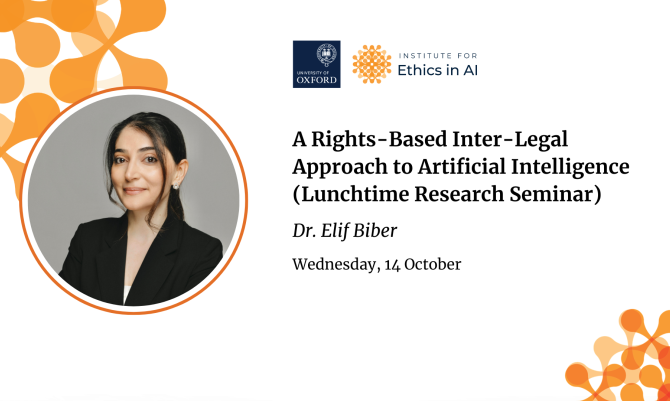
The seminar builds on the core arguments of the monograph A Rights-Based Inter-Legal Approach to Artificial Intelligence, published by Hart Publishing in May 2026. The book argues that (i) artificial intelligence (AI) is transforming the protection of fundamental rights, extending its impact beyond privacy and data protection to equality, due process, access to public services, freedom of expression, human dignity, and democratic participation.
The seminar approaches AI as (ii) a socio-technical phenomenon shaped by data, algorithms, institutions, human oversight, and economic incentives. AI systems actively mediate decision-making processes and redistribute power across public and private actors. It critically (iii) examines the EU Artificial Intelligence Act and argues that, although it represents an important regulatory milestone, its risk-based approach may remain insufficient to ensure comprehensive rights protection, accountability, and effective remedies.
Drawing on (iv) inter-legality theory, the seminar introduces a rights-based inter-legal approach to AI governance. It conceptualises law as a dynamic constellation of interacting legal orders, including national law, EU law, international human rights frameworks, and private normative frameworks. This approach is particularly suited to AI because AI systems operate across borders, sectors, and regulatory domains. By examining how legal and normative layers interact, overlap, and conflict, it offers a more adaptable model for addressing regulatory gaps, limiting power asymmetries, enhancing accountability, and strengthening the rule of law in digital society.

Dr. Elif Biber is a legal scholar in European Public Law and Digitalisation at the University of Luxembourg. She was an academic visitor at the University of Oxford’s Institute for Ethics in AI in May and June 2025, and since February 2023 has served as Head of Digital Rights at The Digital Constitutionalist.
Her research focuses on fundamental and human rights in the digital age, artificial intelligence regulation, digital constitutionalism, inter-legality, and the relationship between rights, risks, and remedies in European law. She holds a PhD in Law, awarded cum laude with the highest distinction, from the Sant’Anna School of Advanced Studies in Pisa, where her dissertation developed a rights-based inter-legal approach to the human and fundamental rights challenges posed by artificial intelligence systems.
She is the author of A Rights-Based Inter-Legal Approach to Artificial Intelligence, published with Hart Publishing, and co-editor of the forthcoming volume Artificial Intelligence in European Law: A Deep View, to be published by Nomos in the Luxembourg Legal Studies series. Her work has appeared with Oxford University Press, Hart Publishing, Nomos, Springer, Il Mulino, the International Review of Law, Computers and Technology, the Italian Law Journal and the Journal of AI Law and Regulation, I·CONnect, Verfassungsblog, EU Law Live, and The Digital Constitutionalist. Her research has been presented at leading academic and policy institutions across Europe, including the University of Oxford, the European University Institute, King’s College London, Paris 1 Panthéon-Sorbonne, Sant’Anna School of Advanced Studies, CPDP Brussels, ICON•S, the European Commission, and the Benelux Interparliamentary Assembly.