
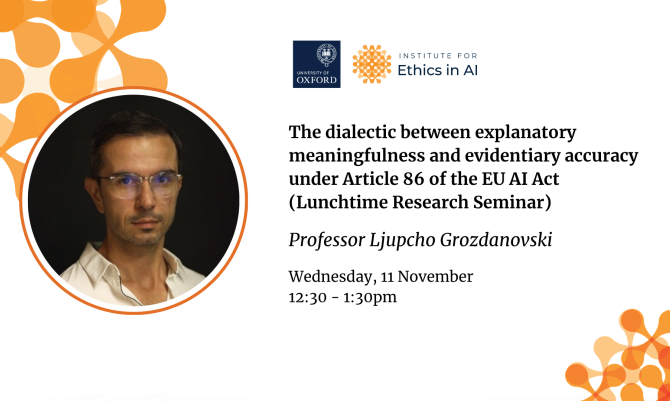
Professor Ljupcho Grozdanovski
Abstract
The EU AI Act, in Article 86, recognises a right to a meaningful explanation of decisions made or assisted by certain high-risk AI systems. Yet the notion of ‘meaningfulness’ remains under-theorised. This presentation approaches meaningfulness through an epistemology of sense-making and a human-centric understanding of legal meaning. It argues that an explanation should not be assessed merely by the amount of information disclosed or by the technical transparency of an AI system. Rather, its meaningfulness depends on whether the information provided is relevant, sufficiently accurate, understandable and - importantly - individualized i.e. enables the individual to exercise their rights effectively, in their specific AI-related context.
The argument develops two complementary dimensions of meaningfulness. The first is explanatory: individuals should receive knowledge of the facts necessary to understand why a decision was taken and, importantly, how the AI system affected them in their particular circumstances. The second is procedural: explanations should provide individuals with meaningful opportunities to participate, contest the decision and seek redress. Drawing on European case law (CJEU, ECtHR) and emerging litigation concerning algorithmic decision-making, the presentation argues that meaningful explanations are necessarily recipient-oriented and individualized.
It further proposes that the meaningfulness of an explanation depends not only on the accuracy of the information communicated, but also on the accuracy of the verification of the AI system’s actual impact on the individual. If the factual assessment of how a high-risk AI system influenced an individual’s outcome is itself incomplete or inaccurate, even a clear and technically accurate explanation may fail to provide meaningful knowledge. Accurate impact verification is therefore a necessary foundation for meaningful explanation, effective contestation and, ultimately, the exercise of the right to redress under the AI Act.
12:30pm-1:30pm - Seminar
1:30pm-2:30pm - Networking Lunch (for those registered to attend in person)
In-person Venue: The address will be sent to you once you register.
Remote: The connection link will be sent to registered attendees (usually the day before the event).
These sessions will run fortnightly during term time. A new form will need to be completed for each seminar so that you receive the relevant joining instructions.
For more information about our events and other news, please subscribe to our mailing list.

Professor Ljupcho Grozdanovski is a Research Associate Professor (National Research Foundation – FNRS/University of Liège), where he currently spearheads two research projects, KNOW.THY.AI and ALPINE, on evidence and procedural justice in the field of Artificial Intelligence (AI). His research explores the procedural means and entitlements that can - or should - be afforded to private parties to enable them to effectively make their views known before a court and seek justice on the basis of European Union law (EU law).
Prior to receiving tenure, Ljupcho taught EU law and international law at the University of Nantes (2021–2022) and was a member of the 2020–2021 class of the Émile Noël Fellowship at NYU School of Law, under the direction of Professors Joseph Weiler and Gráinne de Búrca. During this Fellowship, he conducted a research project aimed at developing a fairness-based general theory of evidence in EU law. He was also a Visiting Researcher at the Ethics in AI Institute, University of Oxford (2024), where he conducted research on the interrelationship between procedural fairness, the explainability of (harmful) AI outputs, and the evidentiary causal explanations advanced by litigants in disputes concerning so-called AI liability.
Ljupcho completed his BA in Law (2006) and holds a Master’s degree in International Law and European Studies (2007), as well as a Master’s degree in EU Law (valedictorian, class of 2008), from the University of Strasbourg. In 2015, he defended his doctoral dissertation, under the supervision of Professor Valérie Michel, on “Presumption in EU Law”(summa cum laude, University of Aix-Marseille, France). His dissertation provides a comprehensive analytical framework for the principles governing the adducing, assessment, and rebuttal of presumptive evidence in both EU institutional law and EU substantive law.
During his doctoral research, he worked as a research and teaching assistant (2009–2014) at the University of Geneva. Following a postdoctoral position at the University of Neuchâtel (2016–2018), he completed a postdoctoral research project at the University of Liège (2019–2020), focusing on AI’s labour-replacement effects.
In line with the research projects he currently conducts within his FNRS position, Ljupcho was awarded by the European Commission the Jean Monnet Centre of Excellence label in 2023. He serves as Director of the Justice and AI Jean Monnet Centre of Excellence – Judicial Redress in the Rising European and Global AI Litigation (JUST-AI JMCE).
His fields of research include Theory of Legal Evidence, Theories of Justice, Legal Reasoning and Epistemology, New technologies and Data Protection, EU Institutional Law, EU Substantive law.
Hosts

Dr Federica Fedorczyk is an Early Career Research Fellow at the Institute and a Research Fellow at Reuben College. Federica’s research lies at the intersection of criminal law, tech law and human rights. She examines how the use and regulation of AI are transforming contemporary criminal justice systems and reshaping the balance between public security and individual rights.

Dr Keri Grieman is an Early Career Research Fellow in Ethics in AI (AI and Law) and a research fellow at Oriel College. She is an Associate Member of Oxford’s Department of Computer Science. Keri is the author of Law, Death, and Robots: The Regulation of Artificial Intelligence in High-Risk Civil Applications, published by Hart.